
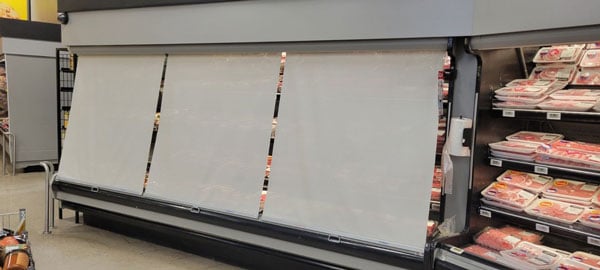
What changes overnight in open multi-deck cases and how to compare performance without guesswork
Open multi-deck display cases are a staple in grocery stores, convenience stores, and supermarkets. They offer easy access for customers and provide visibility for fresh produce, dairy, meats, and other perishable goods. However, these cases face a key operational challenge after store hours: maintaining cold temperatures overnight. Without intervention, warm air infiltrates the case, accelerating spoilage, increasing energy use, and affecting next-day product quality.
Retailers often weigh two common solutions: night covers and air curtains but understanding their relative effectiveness is essential for informed decisions.
Why Temperature Management Matters Overnight
During business hours, display cases rely on open access and refrigeration to maintain product quality. After hours, several factors can compromise cold air retention:
- Ambient store temperatures rise when the case is open and uncovered.
- Refrigeration compressors cycle more frequently to maintain set points.
- Moisture condensation and uneven cooling occur, increasing spoilage risk.
These factors impact not only energy consumption but also shrink, shelf-life, and operational costs. The right overnight strategy ensures cases stay cold, reducing spoilage and improving next-day product appearance.
Air Curtains: How They Work
Air curtains create a continuous vertical flow of air across the open front of a display case. Their intended benefits include:
- Slowing the infiltration of warm store air
- Maintaining temperature at the case front
- Reducing debris and airborne contamination
- While air curtains provide some temperature protection, they have limitations:
- Air velocity can vary across the case, leaving cold air vulnerable at corners or lower shelves
- They consume additional energy to maintain airflow, adding to operational costs
- Ineffective sealing means back rows and deeper shelves may still experience temperature drift
- Air curtains are often better suited for short-term protection during peak traffic rather than overnight use.
Night Covers: How They Work
Night covers, such as those offered by www.nightcovers.com, are physical barriers placed over the open face of a display case after closing. Their benefits include:
- Energy Savings: Covering cases reduces compressor cycles by limiting cold air escape, often achieving energy reductions of up to 20%.
- Temperature Stabilization: A sealed cover prevents warm air infiltration, keeping products at a consistent temperature throughout the night.
- Reduced Food Waste: By maintaining cooler temperatures, night covers slow spoilage, dehydration, and oxidation, which reduces daily discard rates.
- Unlike air curtains, night covers provide full physical protection, making them highly effective for extended off-hours periods.
Comparing Performance: Night Covers vs Air Curtains
When evaluating which solution best preserves cold, consider the following:
1. Temperature Retention
- Night covers consistently maintain stable temperatures across all shelves and trays
- Air curtains primarily protect the front edge, leaving rear products more vulnerable
2. Energy Efficiency
- Night covers reduce refrigeration demand by preventing cold air loss
- Air curtains require power to operate fans continuously, which can offset energy savings
3. Product Protection
- Night covers shield items from ambient heat and light exposure
- Air curtains offer minimal protection against dehydration, surface drying, or oxidation
4. Ease of Implementation
- Night covers are simple to install and remove, requiring minimal staff training
- Air curtains may involve retrofitting, electrical work, and ongoing maintenance
5. Long-Term ROI
- Night covers deliver measurable savings through reduced energy costs and less product waste
- Air curtains provide limited overnight benefit and may have higher upfront and operational costs
Best Practices for Using Night Covers
- Ensure Proper Fit: Covers should fully seal the display case without gaps to prevent cold air leakage.
- Consistent Use: Implement standard operating procedures so staff reliably cover cases each night.
- Combine With Food-Safe Lighting: Balanced-spectrum lighting like Promolux LEDs preserves product appearance during display hours while night covers maintain overnight temperatures.
- Monitor Performance: Track energy savings, product quality, and shrink rates to quantify benefits and adjust processes as needed.
Case Studies and Results
Retailers implementing night covers often report the following:
- Reduced overnight energy consumption by 15–20%
- Consistent temperature across all shelves, including back rows and corners
- Lower product discard due to temperature-related spoilage
- Improved customer perception, with products appearing fresher the next day
These results demonstrate that night covers provide both operational and financial advantages over air curtains for overnight protection.
Conclusion
While both night covers and air curtains have roles in store operations, night covers are the most effective solution for maintaining cold temperatures in open multi-deck cases after hours. They provide measurable energy savings, consistent temperature stabilization, and reduced food waste. Air curtains may be helpful during business hours for temporary protection but cannot replace the overnight performance of a sealed cover.
For grocery operators and store managers seeking practical, high-impact solutions to protect perishable products overnight, night covers are a cost-effective and reliable option. For more information on selecting the right night covers for your display cases, visit www.nightcovers.com and explore solutions designed to improve sustainability, reduce shrink, and maintain product quality.